
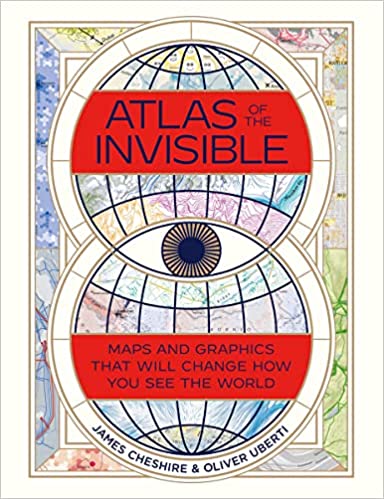
From the Publisher

|
|
|
|
|---|---|---|


Editorial Reviews
Review
― Hannah Fry, Professor in the Mathematics of Cities and author of The Complete Guide to Absolutely Everything
“Fantastic…a magical combo of art and graphic gut-punch.”
― Dave Eggers
“Page after page, graphic after graphic and text after text, Atlas of the Invisible erupts with a kind of rigorous wonder. Laying out patterns on everything from nomenclature to bike-sharing to unexploded ordnance, Cheshire and Uberti examine data sets you never even thought of in the interest of developing a portrait of the world as it is. The result is a strange and startling masterpiece.”
― Matthew Specktor, author of American Dream Machine
“A stone cold act of genius.”
― Dan Snow, HistoryHit
“Spectacular and truly Humboldtian.”
― Andrea Wulf, author of The Invention of Nature
“James Cheshire and Oliver Uberti’s extraordinary new book, Atlas of the Invisible transforms our understanding of our human selves, other lives on earth, and the planet we share. Packed with revelatory insights, the book is a masterful example of the power of compelling visual storytelling to reveal – from within the complexities of modern data chaos – meaning and knowledge otherwise hidden from view.”
― B. Natterson-Horowitz, MD, bestselling author of Zoobiquity
“An absolute visual delight.”
― Manuel Lima, author of The Book of Circles: Visualizing Spheres of Knowledge
“If you’re into #dataViz, you *need* to have this one… Every page reveals a surprise.”
― Alberto Cairo, Knight Chair in Visual Journalism at the University of Miami and author of How Charts Lie
“Gorgeous… Digging [through] troves of data, [Cheshire and Uberti] paint an essential portrait of Where We’ve Been, Who We Are, & How We’re Doing. Imagine Morpheus explaining The Matrix to you―only he’s also a BRILLIANT graphic designer.”
― Minh Le, bestselling author of Lift, Drawn Together, on Twitter
“Stunning.”
― Valerie Trouet, author of Tree Story, on Twitter
“An eye-opening visual look at the assumptions and trends that lie beneath how the modern world ticks.…Demography and graphic design meet in an extraordinarily revealing book.”
― Kirkus Reviews (starred review)
“Atlas of the Invisible takes this literally, with design-heavy info-mapping of cellular connections in the Great Lakes, eviction rates, the ethnicity of immigrants living on South Halsted Street in 1895. A cartographer’s dream, and often revelatory.”
― Christopher Borrelli, Chicago Tribune
“[T]his unique volume.…is designed to inspire readers to act.”
― Library Journal
“An endlessly fascinating array of insight and analysis.”
― Mark Reynolds, Traveller Magazine
From the Back Cover
From the Preface:
“For centuries, atlases depicted what people could see: roads, rivers, mountains. Today, we need graphics to reveal the invisible patterns that shape our lives. Atlas of the Invisible is an ode to the unseen, to a world of information that cannot be conveyed through text or numbers alone.”
Praise for Where the Animals Go:
“A striking example of how innovative technology can be used to increase our understanding of the natural world.”
―Alan Smith, Financial Times
“An enthralling volume, downright gorgeous in its illustrations and text.”
―Barbara J. King, NPR
“Beautiful as well as inspiring.”
―Dr. Jane Goodall
“A combination of the best in science and exposition, and a joy to study cover to cover.”
―E. O. Wilson
About the Author
Oliver Uberti is a Los Angeles–based designer and a former design editor for National Geographic.




Michael Jabot –
I work with future scientists and science teachers. This work is simply the best example I have ever seen on how we can share data in ways that communicates deeply what we “thought we knew”. Will become my go-to resources for these students.
Amazon Customer –
Liked it amazingly it was given as a gift to a person who cares about Maps in the world.
Alison M. Boyd –
Insightful, surprising, stunning to look at. A must have for anyone interested in data, maps or the world we all live in.
Ken M. Brown –
Graphics were incredible and the narrative along with them made for a compelling story.
S. Sloan –
I had heard that this was a special book unlike any other atlas in content and execution. The authors’ goal is to make dense data sets tell their stories by providing proportionality and time elapsed to that information. It isn’t dry stuff. It is a wonder.By portraying data about such things as trafficked humans over the period of transatlantic slavery—where they came from and where they went—in graphic form over time, I learned some important truths not often understood, such as that Brazil received more Africans into slavery than any other destination. Other presentations include amount of light in the night sky over time to present the impact of war in Syria, effects of human migration, effects of climate change and many other topics. I gave a copy to my inquisitive 11-year-old grandson at Christmas, and it’s provided hours of family discussion.