
Editorial Reviews
Review
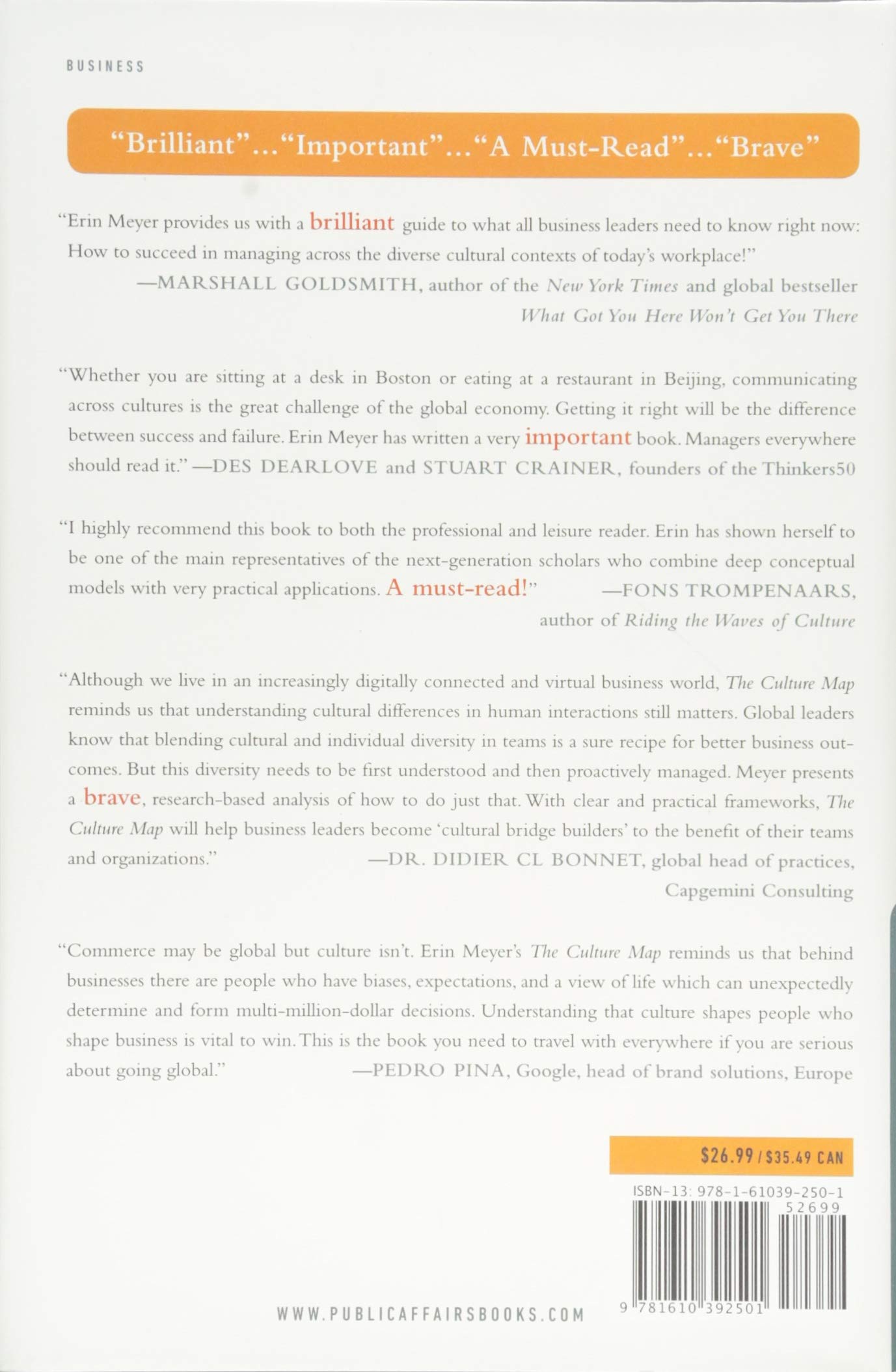
“Erin Meyer provides us with a brilliant guide to what all business leaders need to know right now: How to succeed in managing across the diverse cultural contexts of today’s workplace!”―Marshall Goldsmith, author of the New York Times and global bestseller What Got You Here Won’t Get You There
“Whether you are sitting at a desk in Boston or eating at a restaurant in Beijing, communicating across cultures is the great challenge of the global economy. Getting it right will be the difference between success and failure. Erin Meyer has written a very important book. Managers everywhere should read it.” ―Des Dearlove and Stuart Crainer, founders of the Thinkers50
“Whether you’re a corporate or traditional diplomat, global traveler, government official, or passionate world citizen, this is the one book you should not miss. Chock-full of real-world examples and a simple framework that can be utilized in any cross-cultural context, Meyer’s work is characterized by a fresh and relevant voice, distilling down the essentials of communicating, persuading and working effectively around the globe. It is rare that I pick up a cross-cultural book and can’t put it down.”―Cari Guittard, Huffington Post
“With business becoming ever global, there are a raft of books available on dealing with cultural differences. If you only read one, make it INSEAD professor Erin Meyer’s…Skillfully blend[s] real-life examples…with an analytical framework… What brings this book to life are the numerous examples Meyer has encountered, both in her own life as an American living in Paris, and in her experience as running the Managing Virtual Teams module at INSEAD.”―HR Magazine, 5 star review
“The book abounds with well-chosen anecdotes to illustrate the misunderstandings that can arise from clashing cultural assumptions, making this enlightening book a pleasure to read.”―Foreign Affairs
“Amusing.”―Financial Times
“This readable book explains how to dramatically increase organisational success by improving our ability to understand the behaviour of colleagues, clients, and suppliers from different countries.”―Professional Manager (UK)
“A helpful guide to working effectively with people from other cultures…Meyer delivers important reading for those engaged in international business.”―Kirkus Reviews
“In a relaxed, entertaining, but always knowledgeable style, Meyer draws on numerous examples from her experiences to explain how to detect the invisible barriers in the global business world–and how to get past them.”―Siemens Industry Journal
About the Author
Erin Meyer is a professor at INSEAD, one of the world’s leading international business schools. Her work focuses on how the world’s most successful global leaders navigate the complexities of cultural differences in a multicultural environment. Living and working in Africa, Europe, and the United States prompted Meyer’s study of the communication patterns and business systems of different parts of the world. Her framework allows international executives to pinpoint their leadership preferences, and compare their methods to the management styles of other cultures.
Her work has appeared in Harvard Business Review, Singapore Business Times, and Forbes.com. In 2013 Erin was selected by the Thinkers50 Radar list as one of the world’s up-and-coming business thinkers. She is the recipient of the 2015 Thinkers50 RADAR Award. With Reed Hastings, she is the co-author of No Rules Rules: Netflix and the Culture of Reinvention. Follow her on Twitter: @ErinMeyerINSEAD






Professor H –
I used this as a textbook for an undergraduate cross-cultural studies class in an international business management program. The book was relevant to the course for these students.The author gave multiple examples involving diverse countries from her own experience and qualitative research. The majority of the examples were European and US-based but also included several Asian cultures and a few examples from South and Central America. Very few examples were given from nations in Africa.What I appreciate most about Meyer’s work was that each cultural approach was appropriate in its own setting. There are no “right” or “wrong” cultural practices. She highlights the difficulties encountered when one person or group works with another person or group that has different expectations. She provides strategies for managers working with multi-cultural teams and strategies for those working cross-culturally with a team from a culture different than their own.The author mentions several of Hofstede’s dimensions and I supplemented the course with additional information from Hofstede’s study.The visual diagrams were enlightening especially when comparing countries with multiple scales. As is usual when studying other cultures, the students had insights into their own cultural approaches.
OERA1 –
I wish I could give more than 5 stars–this book deserves double! If you want to learn something about yourself–please go ahead and read this book. It is not only about business–it is about us!I enjoy seeing the way Erin places countries or cultures on a line and gives everyone a place–and then you can see and appreciate why we behave as we do. Bottom line, for me–is the fact that now I am aware of my own shortcomings when I think something about other people or culture being rude or nice….it is all on the eyes of the beholder! The problem lies on being able to identify our own personal biases.I hope I can teach these principles and explanations to my students and make them aware of the many tools available so that we can be a better global business person/leader/boss/employee….Thank you Erin–what an amazing learning experience!
Doane –
“The way we are conditioned to see the world in our own culture seems so completely obvious and commonplace that it is difficult to image that another culture might do things differently. It is only when you start to identify what is typical in your culture but different from others, that you can begin to open a dialogue of sharing, learning, and ultimately understanding.” (pg. 244)Meyer’s book does just this. She enlightens the reader about their own culture through graphs and stories that also help them to understand how another culture may approach things differently. She discusses culture with a neutrality that makes it safe for everyone reading her book to feel both validated in how they operate and convicted to more open-mindedness towards those who are different.Meyer’s extensive work across cultures is apparent from the beginning the end of this book. Her astute awareness of issues that cause tension between people from different cultural contexts has allowed her to communicate information simply and with plenty of examples which reinforce her points and provide context for effective learning. Meyer breaks down the primary issues which cause cultural disruption into eight categories. She shares cultural tendencies on a scale, which allows for individual and regional differences within a specific culture, as well as an easily digested visual of cultural differences. Meyer often provides historical or linguistic context that helps explain how the differences developed or why a culture may be similar to another or skew completely different directions. As each concept is explained, she layers on the new information so the reader can see how each of the eight categories work together and separately to make a culture unique.“When considering the impact of cultural differences on your dealings with other people, what matters is not so much the absolute positioning of a person’s culture on a particular scale, but rather their relative positioning in comparison to you.” (pg. 44)Through the scale approach, Meyer is able to help the reader navigate the space between their own culture and one in which they may be visiting or doing business. She provides general strategies for working with people on both the left and right of your own culture, as well as in multicultural situations, making it easy to not only understand your own position, but also how to adjust toward another’s comfort zone as well.As communication and transportation technology continue to advance, cultural understanding will be more imperative than ever to business relationships, political conversations, educational institutions, and even leisure travel. This book is a must-read for anyone who anticipates cross-cultural interactions or those who just wants to become more well-rounded by understanding their own culture better.
Keith W –
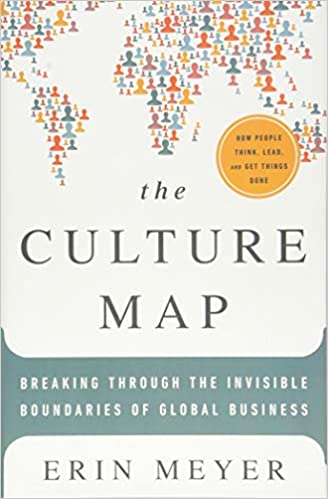
Erin Meyer brings to light many of the cultural and societal intricacies that are present in some of the major countries within the world business market while simultaneously giving you the tools necessary to navigate how those concepts can play out in other countries not mentioned in this book. In reading “The Culture Map”, I found that it became a great benefit to me in that it has helped me understand the underlying issues present in circumstances I’ve been a part of in cross-cultural dealings. Even in situations where I knew something was off, I now have greater understanding and clarity as to what I was missing or doing wrong in those situations.In “The Culture Map”, author Erin Meyer gives 8 scales or graphs that you are able to use to map out and gain understanding to how each culture functions and is wired. Once you map out your native culture on these graphs, you are then able to compare and relate a differing culture to how you are wired. These maps or graphs are something you are able to take with you and use at any time in the future to help you better understand how other people think and process basic, everyday principles and concepts.I highly recommend that everyone read this book, and I do mean everyone! Writing from a United States perspective, we all interact with people from differing cultures than our own. As cultures continue to blend with immigration and the ability to move freely about much of the world, we are bound to have interactions with people from other cultures…maybe even live next door to them. “The Culture Map” is written with business people and dealings in mind; however, I found that the concepts within this book are extremely useful in interacting with neighbors and friends from a differing culture than your own.Don’t hesitate to pick up this book for an enlightening read!
Avid Readers –
Really good for international relations. I work in a global role. I can’t tell you the number of times I’ve had a German, an American, and a Chinese person all on the same call. The cultures are so different that the interactions can quickly go awry. The German will be the most abrupt, seeming to interrupt, being totally blunt, and not realizing he could offend. The Chinese will be the quietest, waiting to ask their turn to speak, sometimes having an underlying meaning behind the words that isn’t blunt, and being very careful to not offend. The American will be in the middle. What could happen is that the Chinese person finds the German to be a rude, heartless boor. The German will think the Chinese person not forceful, not direct enough, and pussy-footing around. The reality is, we all have different cultural heritages which overlay our perceptions that we aren’t fully aware of. Meyer has worked quite a bit internationally and has 8 attributes where the different cultures are put on various continuum. After reading this, I came away being more effective in my global interactions and have now led several discussions successfully. And of course, learning to be aware of my own cultural issues…